
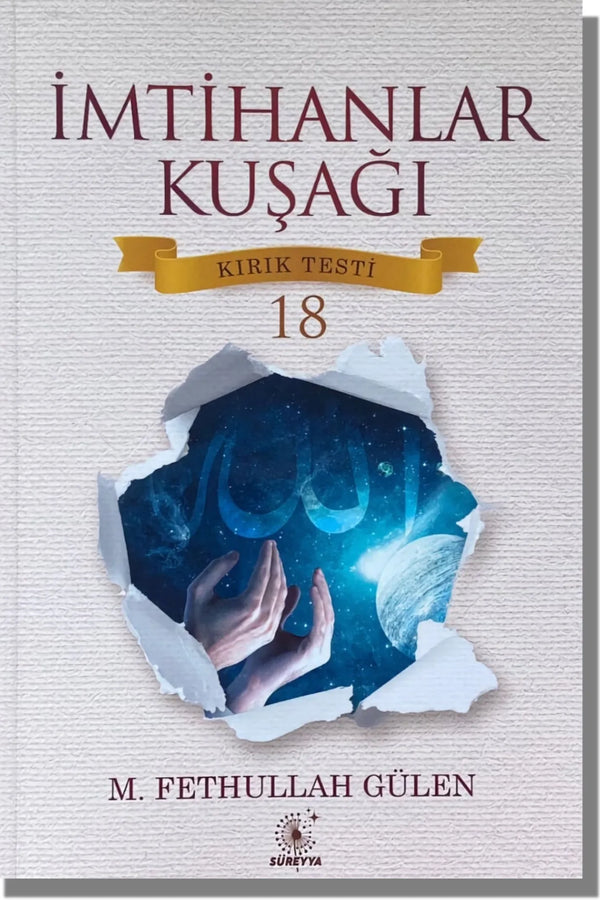

Book
Ne Dediler Seti
£43.00
Tax included · Shipping calculated at checkout
Free shippingOver €59 in NL
1–3 business daysFast dispatch
Secure paymentiDEAL · Card · PayPal
14 days returnNo questions asked
Secure paymentiDEAL · Card · PayPal
PublisherUitgeverij De Rijn
TypeBook
About the Book
Philosophy of Mathematics
The tendency towards mathematics from philosophy is perhaps as old as the history of philosophy. In Plato's Academy, "Those who do not know geometry cannot enter." it said. Galileo: “The language of the universe is mathematics.” Alfred North Whitehead said, "Mathematics, along with music, is perhaps the most important product of the human soul." he said. Spinoza and Descartes act with the idea of more geometrico when proving the existence of God; Talking about geometry, Hobbes wrote, 'the only science bestowed upon mankind'.
In the Philosophy of Mathematics compiled by Bekir S. Gür, the possibility of mathematical knowledge, the nature of mathematical epistemology and ontology, the existence of mathematical objects and the basic paradoxes in the history of mathematics;
Like Russell, Hilbert and Gödel, the cult of the philosophy of mathematics
are written with their names.
Philosophy of Education/Philosophy of Education Articles
The book you have in your hand consists of world philosophy of education articles compiled and translated by educational philosopher Sabri Büyükdüvenci.
Van Cleve Morris, Philip G. Smith, Arnold B. Levison, Israel Scheffler, Curt John Ducasse, Charles J. Brauner,
Hobert W. Burns, Paul Nash, John S. Brubacher, Theodore Brameld, M. A. B. Degenhardt,
are some of these names.
We also present to our readers Philosophical Education, which includes Sabri Büyükdüvenci's writings on love education, Atatürk's philosophy of education and lifelong education, with the presentation of Saffet Bilhan.
Knowledge and Value
It is a known fact that modern people live in an age of crises. There are signs of this in almost every field; It is also possible to see this in the global wars of opposing ideologies, in the natural and social upheavals created by technology, and in the crazy-fast lifestyle that increasingly threatens human existence.
Peace is talked about, but social relations are dominated by suspicion, fear or anger. Economic prosperity is talked about, but we are stuck in debt. Freedom is mentioned, but freedom is equated with the sameization of people. Equality is mentioned, but equality is perceived as punishment for merit. It is clear that the result of these irregularities will sooner or later be chaos. I wonder why we are in this situation and is there any way to get out of this situation? In fact, what is in question here is nothing other than the problem of 'value', which is one of the three basic issues of philosophy along with existence and knowledge.
So what is meant by 'value'? Does value have any value in itself? Or does 'value' find its value in the concrete forms of social and institutional practices? What makes value 'value'? Are values normative? Is an action based on knowledge or value? Could the feeling of 'duty' be the criterion of values for the modern individual?
In the book in your hand, which seeks answers to all these questions, the nature of 'value' and its relationship with the fields of knowledge and existence are discussed, from Socrates to Kant, Fichte and Hartmann, from Heidegger to Nussbaum and Habermas.
Publication: Fol
Auteur:
Frequently Bought TogetherSimilar Books

35% Off
Sold out
Sold out