No Products in the Cart

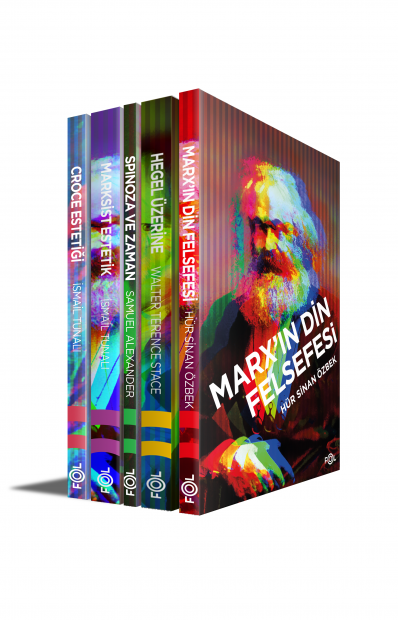
Marx's Philosophy of Religion
A person who takes refuge in religion wants to feel like a spiritual being within capitalist relations that turn everything into a commodity.
Religion becomes a haven where people take refuge against the cruelty of capitalism; It acts as an opium against pain, it relieves the pain. While leaning on religion enables one to tolerate one's place in brutal exploitation relationships, it can also be a form of rebellion.
At this very point, Marx's criticism of religion begins with these words:
It is a critique of capitalism:
“Man is a degraded being inside,
that he is a slave,
is an abandoned being,
is a neglected entity,
overthrow all relationships!”
Thus, the criticism of heaven turns into the criticism of the world, the criticism of religion turns into the criticism of law, the criticism of theology turns into the criticism of politics.
We present this valuable work, written by Hür Sinan Özbek, in which all aspects of Marx's philosophy of religion are discussed.
Spinoza and Time
According to Alexander, the most characteristic feature of recent periods is the discovery of Time and our realization that things have an essential content. So what is Time?
Is it an essential content of things? Or is it the mind of Space?
Or are they just fictions of our minds?
What does Time mean in the context of a concept of God identical to Substance?
How do Einstein and Whitehead read this discovery of the fourth axis?
According to Bergson, what does it mean for time to be the ultimate reality?
Samuel Alexander, one of the founding thinkers of the emergentism school, traces the understanding of 'Time' and 'Space' in Spinoza's philosophy in the light of new views in his work Spinoza and Time.
Marxist Aesthetics
How does Marx, who describes the Hegelian dialectic as a 'mystification', turn it upside down and turn it into a dialectic from below, a materialist dialectic?
According to Marxist aesthetics, what is the object of art and what is the relationship between the artist's subject and this object? What kind of entity is this reality reflected by art?
Does Marxism see art merely as a force, an instrumental force for transforming the world?
Can't this power be used to dominate nature?
What is social realism as a view and what did it aim to do?
In his work Marxist Aesthetics, İsmail Tunalı discusses the basic discussions of Marxist aesthetics in the light of the views of the founding thinkers of Marxist theory, Marx, Engels and Lenin, as well as contemporary aesthetic theorists Lukács, Fischer and Hans Koch.
On Hegel
Stace himself is a philosophy teacher, but he is not just a neutral philosophy teacher, he is an idealistic philosophy teacher. As an idealist, he believed that Hegel was the greatest and most consistent philosopher who ever lived. As a philosopher who has fully adopted Hegel, he does not attempt to interpret him at all, but only explains Hegel and introduces him. As a person who has scanned all his books, he explains the great 'Hegel System' that emerges from all of these books and shows with what mental inferences are made from this category to the other. This is where the benefit of your book lies. Because thus, before Hegel's words on this or that subject, the methodology that creates Hegelian philosophy and Hegelian dialectics appears.
We present this valuable work, which is an introduction to W. T. Stace's Hegel Philosophy and methodology, with the translation of Murat Belge.
Croce Aesthetics
What is the difference between 'intuitive knowledge' and 'conceptual knowledge'?
What is the place of the concept of 'expression' in Croce's philosophy of language and knowledge?
Is there an 'art intuition' different from general intuition?
According to Croce, what does the 'phenomenon of emotion' mean?
What is Croce's criticism of Schiller's aesthetics and 'Game Theory'?
In the work Croce's Aesthetics, written by our esteemed aesthetic theorist İsmail Tunalı, all these questions will be discussed, as well as the aesthetics, language and epistemology of the Italian philosopher Benedetto Croce.
Hür Sinan Özbek,Samuel Alexander,İsmail Tunalı,Walter Terence Stace
Publication: Fol
Auteur:
Hür Sinan Özbek, Samuel Alexander, İsmail Tunalı, Walter Terence Stace